01
Fast Detection with SGF
Spatial Grid Folding (SGF) converts short-term temporal anomaly perception into efficient 2D visual reasoning, allowing a lightweight module to monitor every incoming stream segment.
ECCV 2026
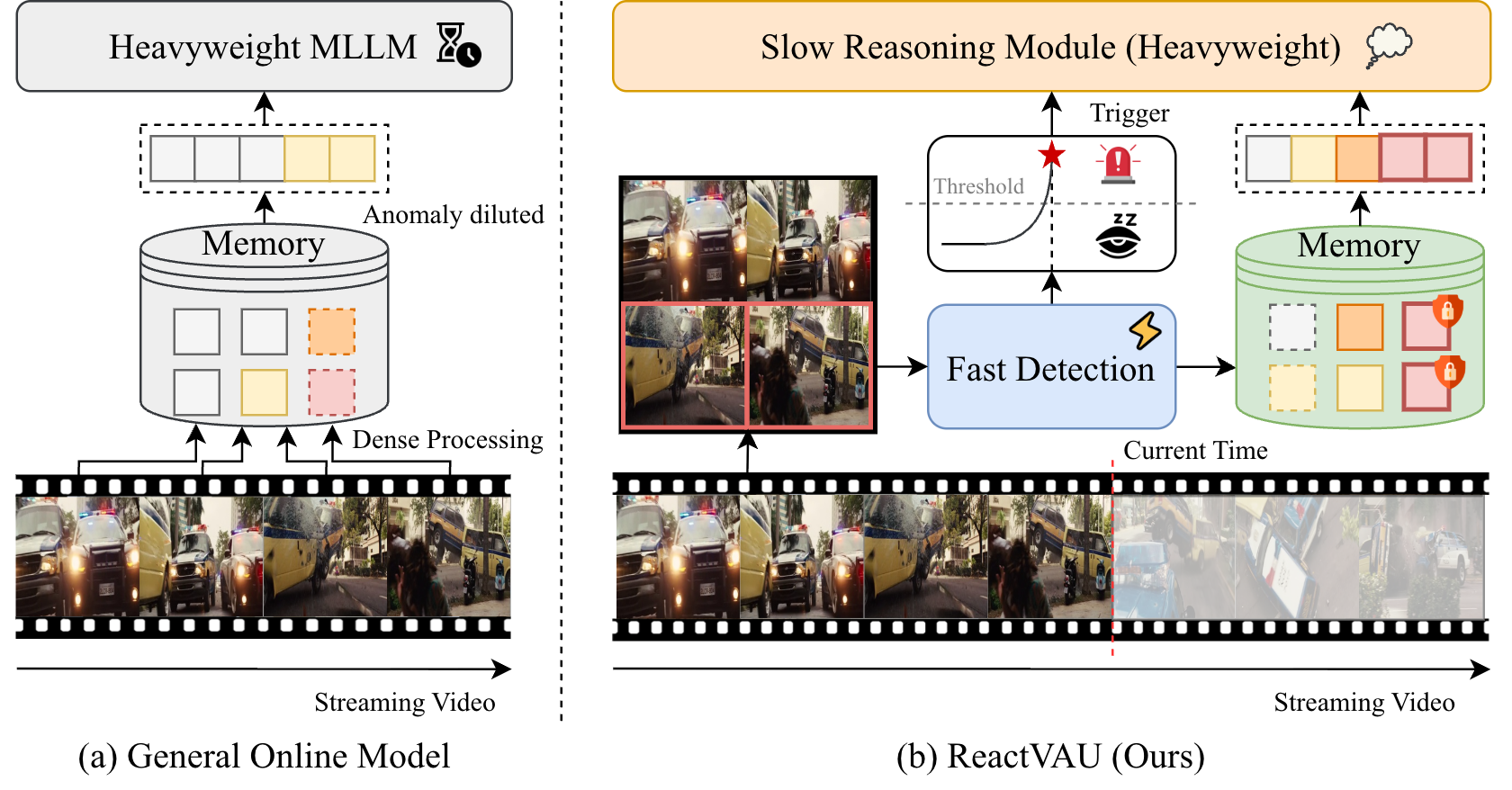
In this paper, we propose ReactVAU, a Slow-Fast Decoupled Framework for real-time streaming Video Anomaly Understanding (VAU). Existing VAU methods rely on offline inference with global temporal sampling, which violates causality and prevents deployment in live surveillance streams. Conversely, general streaming video models satisfy causal access but dilute rare transient anomalies during memory compression and often invoke heavyweight MLLMs uniformly over long normal intervals.
ReactVAU addresses this gap with three synergistic components: a lightweight Fast Detection Module based on Spatial Grid Folding (SGF) for continuous anomaly filtering; an Anomaly-Aware Persistent Memory (AAPM) that protects critical visual cues from temporal decay; and a heavyweight Slow Reasoning Module that remains dormant during normal streams and is awakened only by suspicious events for semantic verification and causal description. Extensive experiments demonstrate competitive anomaly detection and causal reasoning under strict streaming constraints, while substantially reducing heavyweight MLLM invocations.
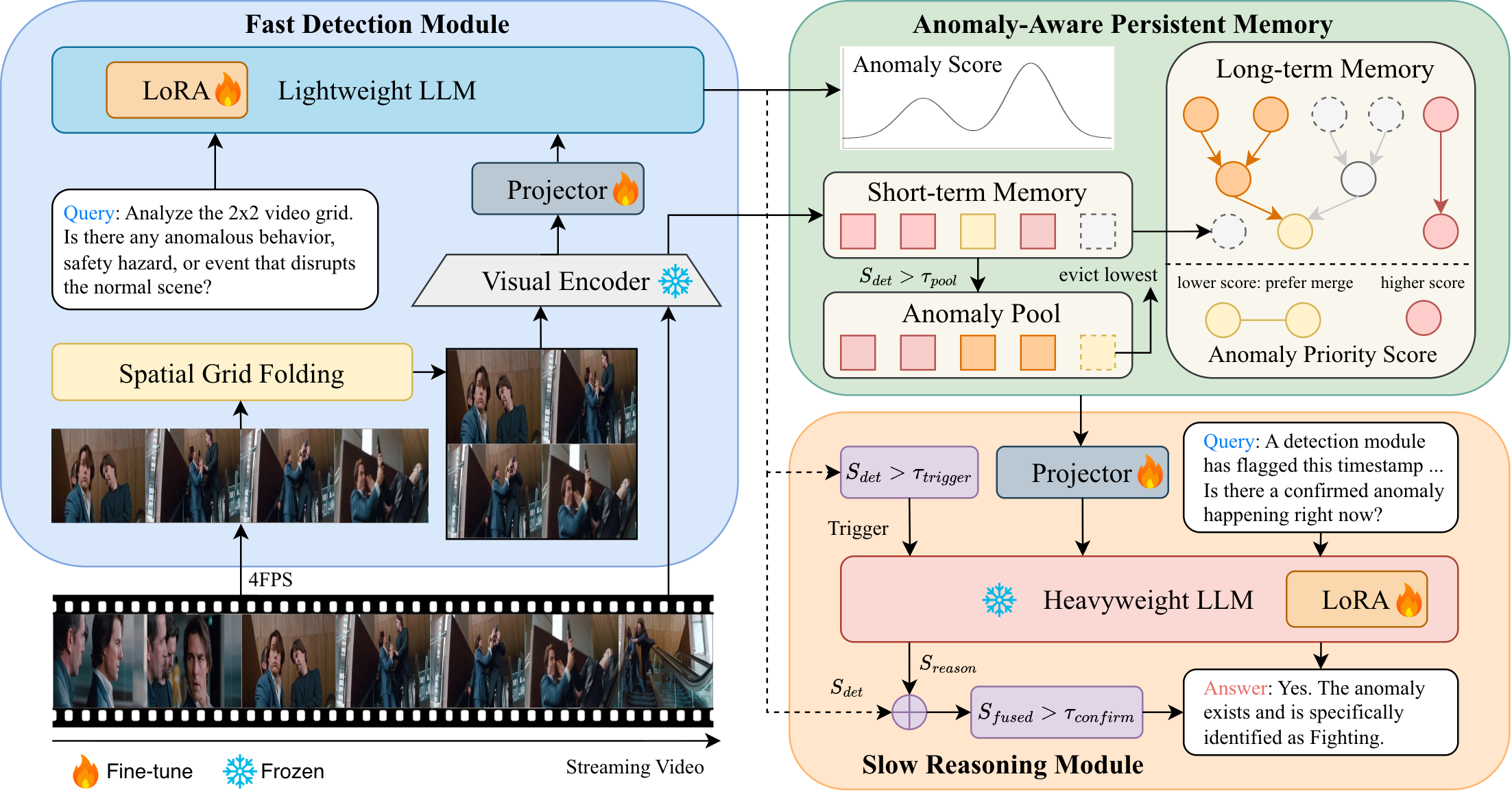
ReactVAU consists of three components: a lightweight Fast Detection Module, Anomaly-Aware Persistent Memory (AAPM), and a heavyweight Slow Reasoning Module. The Fast Module continuously produces an anomaly score via SGF; the score protects critical evidence in AAPM and awakens Slow Reasoning only when an anomaly is detected. The two scores are fused for the final decision and a causally grounded description.
01
Spatial Grid Folding (SGF) converts short-term temporal anomaly perception into efficient 2D visual reasoning, allowing a lightweight module to monitor every incoming stream segment.
02
AAPM uses anomaly priority and a threat-based anomaly pool to preserve sparse, transient visual cues that conventional memory compression would dilute.
03
The heavyweight MLLM sleeps during normal periods and wakes only for suspicious events, providing semantic verification and causal descriptions without future frames.
ReactVAU is evaluated on UCF-Crime, XD-Violence, and HIVAU-70K under a strict causal streaming protocol.
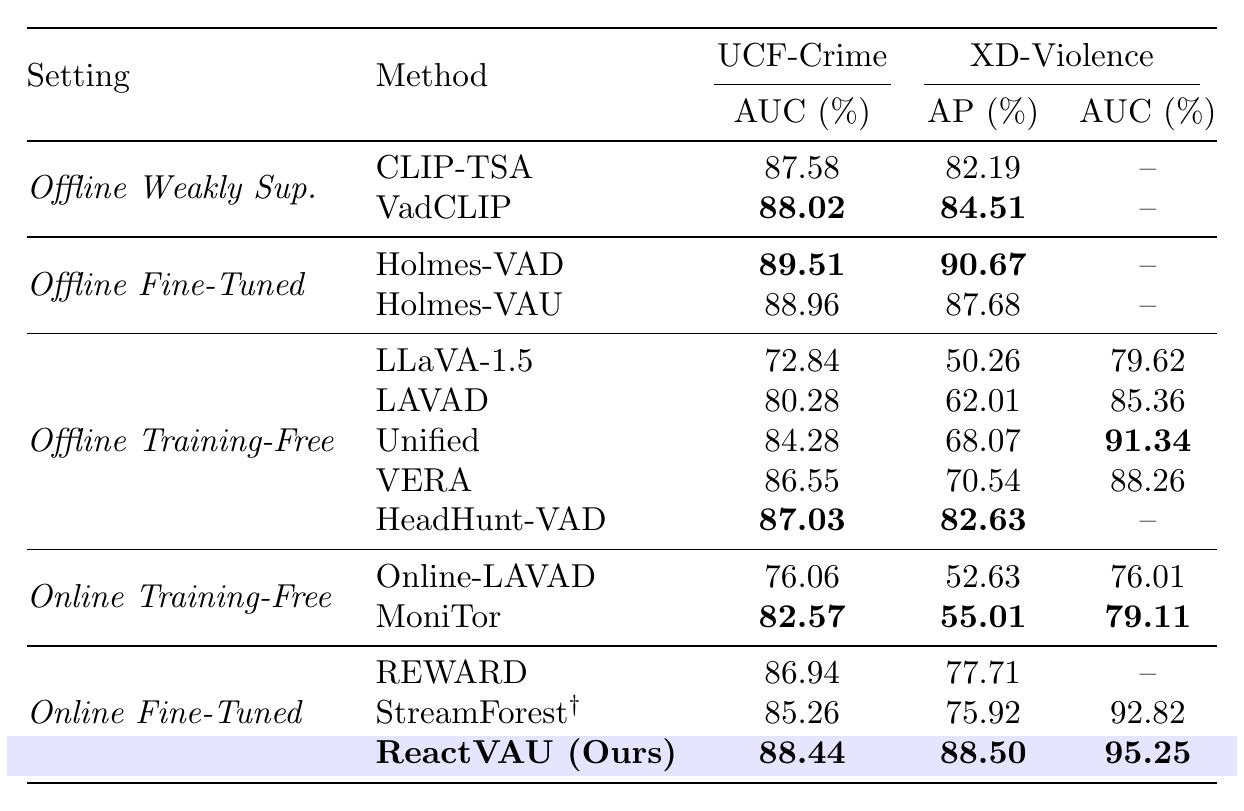
Complete VAD comparison from the paper. ReactVAU surpasses prior online methods on both datasets, while remaining competitive with offline methods that access future frames. Click to enlarge.
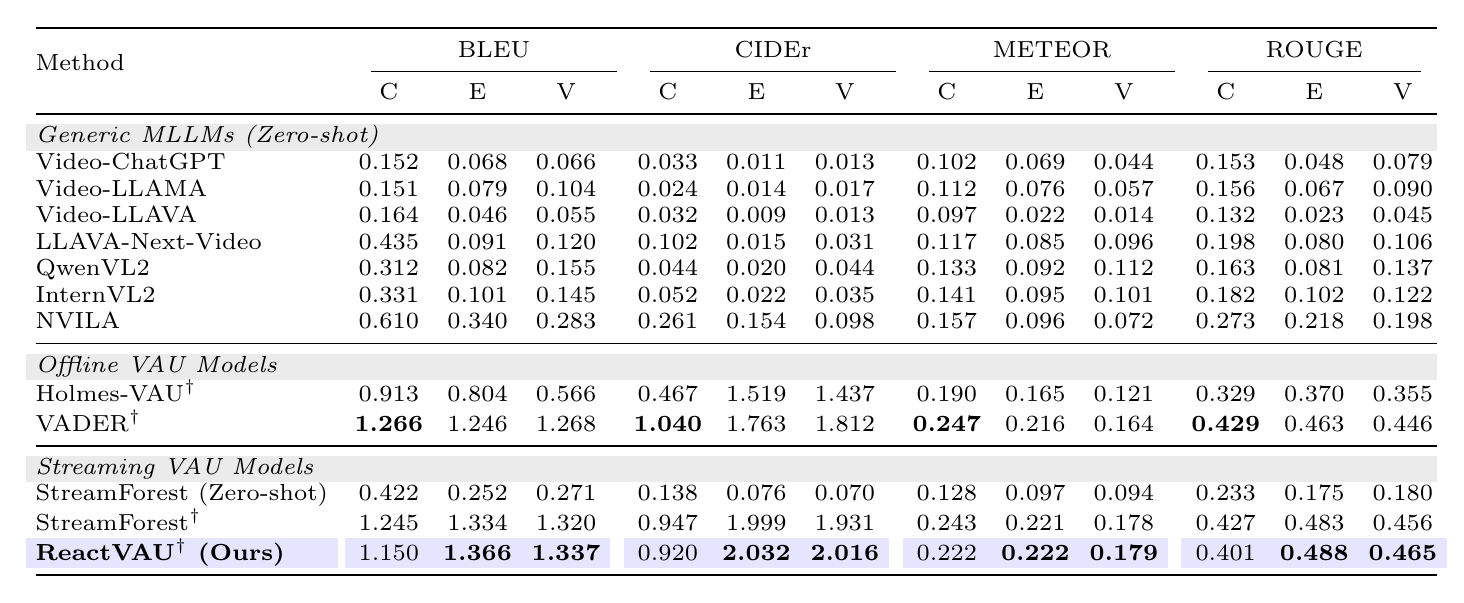
Complete HIVAU-70K VAU comparison from the paper. C, E, and V denote clip-, event-, and video-level evaluation. ReactVAU leads the reported long-range Event- and Video-level metrics. Click to enlarge.
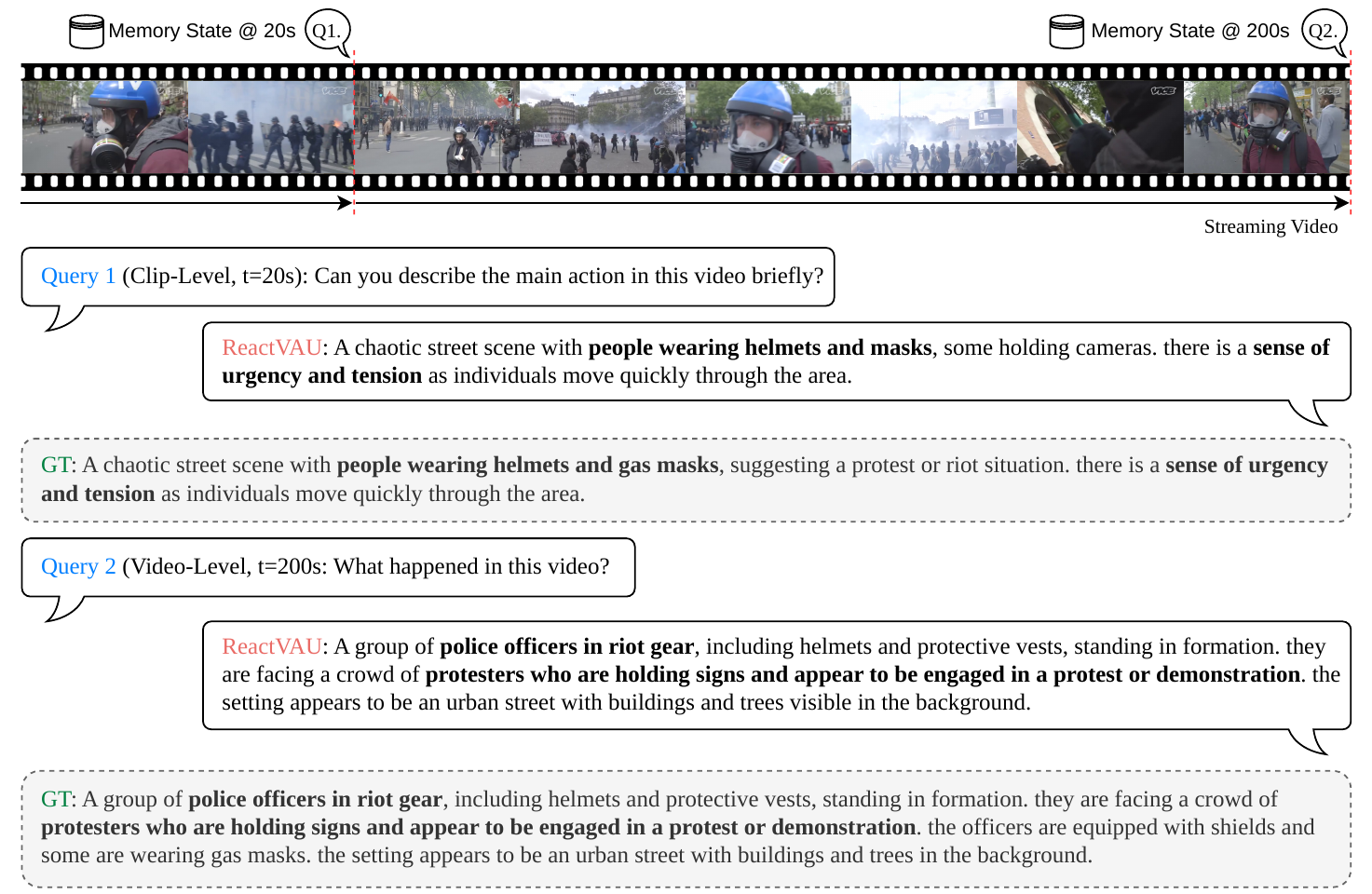
ReactVAU processes the video sequentially and answers each question with only the memory available at that time. AAPM preserves critical evidence—such as escaping rioters and police formations—while normal streaming context continues to arrive.
This enables a localized description at t = 20 s and a holistic video summary at t = 200 s without question-specific global resampling or access to future frames.
ReactVAU processes the input causally as the stream arrives. Every second, the Fast Detection Module outputs an anomaly score while the Anomaly-Aware Persistent Memory (AAPM) updates the available visual evidence, protecting suspicious cues from temporal decay.
At any timestamp, users can ask questions about the stream. The Slow Reasoning Module answers from the memory accumulated up to that moment, enabling anomaly descriptions and causal question answering without accessing future frames or re-encoding the full video.
A qualitative result video of ReactVAU under the streaming setting. Open in Google Drive.
@misc{chen2026reactvau,
  title     = {ReactVAU: A Slow-Fast Decoupled Framework for Streaming Video Anomaly Understanding},
  author    = {Chen, Chia-Hui and Yeh, Shih-Ying and Yang, Fu-En and Chen, Min-Hung and Lai, Shang-Hong},
  year      = {2026},
  eprint    = {2609.07941},
  archivePrefix = {arXiv},
  primaryClass  = {cs.CV},
  url       = {https://arxiv.org/abs/2609.07941}
}